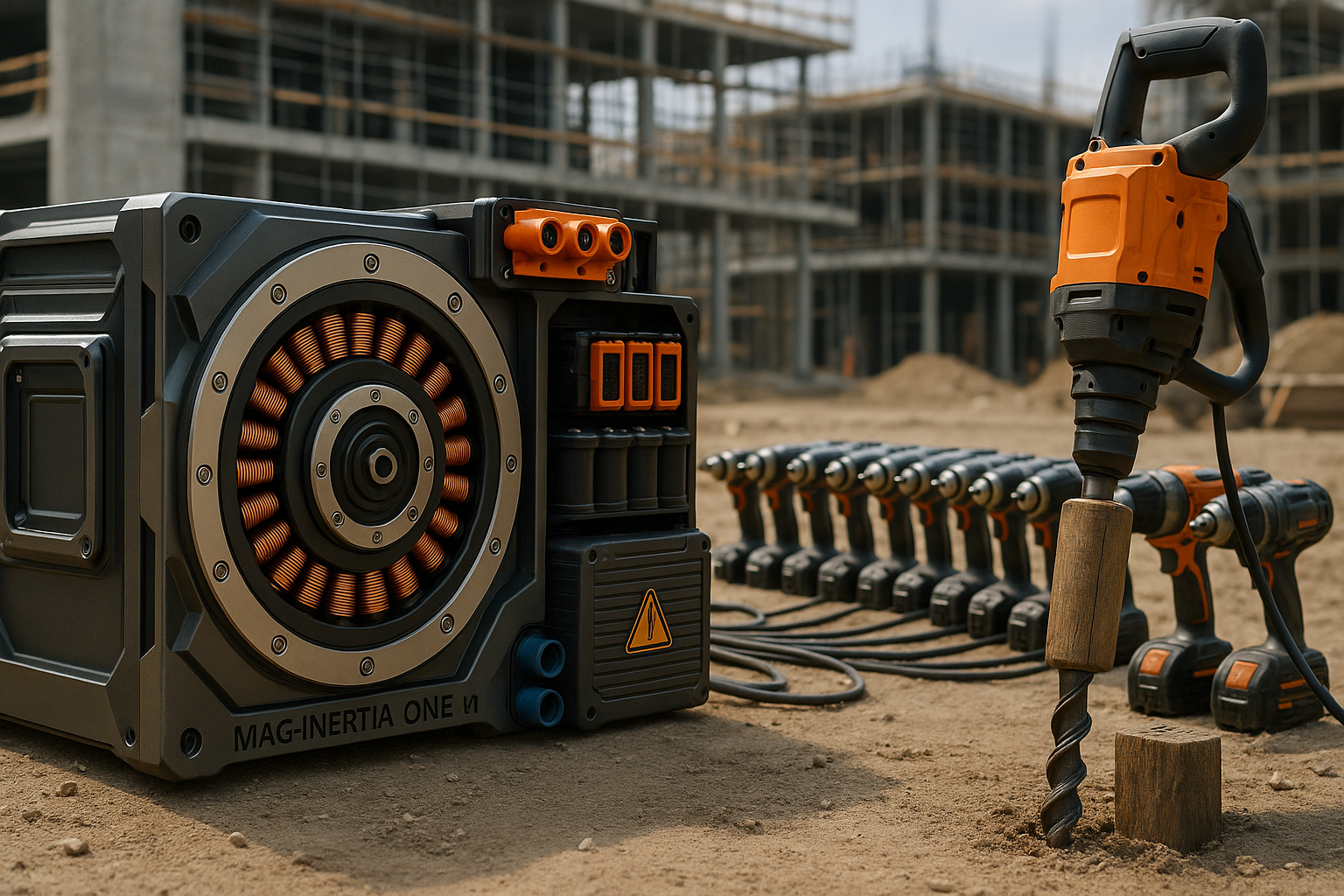
Magnetic Inertia AirProp Engine

Interactive brochure • concept overview • 2026-02-04
IONCORE Aerospace Systems
IONCORE propulsion platform • hybrid-ready magnetic concept

Frictionless rotation, intelligent fields, energy recovery — built to scale.

The Magnetic Inertia AirProp Engine is a high-level propulsion architecture that combines active magnetic bearings, electromagnetic torque control, regenerative energy capture, and optional cryogenic thermal management into a modular core. It’s designed to function as either a hybrid add-on to conventional engines (reducing wear and reclaiming energy) or as an independent electric core for ducted fans, propulsors, or distributed propulsion.

IONCORE Branded Concept Platform Active Magnetic Bearings (AMB) Electromagnets + Field Control Regenerative Energy Capture Battery + BMS / Supercaps Cryogenic Option Hybrid Retrofit or Standalone
What it replaces
High-friction, high-maintenance interfaces

Magnetic levitation support reduces bearing wear, vibration hotspots, and friction losses at high RPM.

What it adds
Energy recovery & intelligent control

Closed-loop sensors and field control can reclaim kinetic energy during spool-down phases and stabilize rotor dynamics.

Where it fits
Drones → regional propulsion → large engines

Designed as a “core module” that scales by stacking power electronics, magnet arrays, and thermal capacity.

Concept visuals (internal)
Promotional concept visual

System Highlights

  • Near-zero-contact support: AMBs levitate the shaft/rotor for low mechanical loss and reduced wear.
  • Dynamic torque shaping: electromagnets apply controlled rotational force and damping.
  • Regenerative capture: harvest energy during decel/spool-down phases into storage (BMS-managed).
  • Sensor-rich health model: Hall / optical encoders + vibration/temperature monitoring for closed-loop stability.
  • Thermal headroom: hybrid air/liquid cooling; optional cryogenic loop for high field stability scenarios.
  • Hybrid integration: installs as a bearing + generator + control module alongside conventional cores.
  • Standalone builds: pairs with electric ducted fans / propulsors as a magnetically optimized drive core.
  • Manufacturing path: modular BOM supports prototyping, then industrial scale through standardized subassemblies.

Note: this brochure summarizes an internal design direction and component architecture. Final performance depends on airframe integration, certification path, materials, thermal envelope, and test validation.

Interactive 3D Preview

A simplified 3D “engine core” preview (for visualization). Drag to rotate. Scroll to zoom.

3D • Concept Core Module Hybrid/Standalone
Page 2 • Technology

Architecture: magnetic support + electromagnetic drive + energy recovery

The design separates the propulsion core into four controllable layers: (1) magnetic support, (2) torque generation, (3) storage & power electronics, (4) thermal management. That modular split is what enables both retrofit and standalone builds.

Layer 1
Active Magnetic Bearings

Levitation coils + position sensors maintain rotor centering and damping without mechanical contact.

Layer 2
Electromagnetic torque

Custom coils apply controlled magnetic force to shape acceleration, stabilize harmonics, and manage RPM bands.

Layer 3
Energy recovery + storage

During spool-down, recovered power routes through DC/DC stages into batteries/supercaps for later burst demand.

Operational Modes

  • Hybrid retrofit mode: retrofit to an existing engine family as AMB + generator/regen + control module (reduces mechanical wear and provides auxiliary power).
  • Standalone electric core: drives ducted fan / propulsor where thrust is produced aerodynamically while the magnetic core provides rotational power.
  • Assist / boost mode: stored energy supplies short-duration bursts for takeoff, climb, or maneuvering (subject to thermal and electrical limits).
  • Stability mode: active fields counter vibration signatures and improve rotor dynamic stability for demanding regimes.

Core Physics (high level)

Magnetic bearing control (closed-loop): position error → coil current → corrective force. In practice this uses high-frequency control loops, redundant sensing, and fault-safe fallback modes.

Energy stored (capacitor): E = 1/2 · C · V²Electrical power: P = V · I

Mechanical power: P = τ · ω (torque × angular speed). For propulsion integration, airframe speed is an aerodynamic outcome, not an engine-only constant.

Efficiency framing: η = P_out / P_in. Loss terms include coil resistance, eddy currents, inverter switching, and thermal leakage.

Core visuals

Illustrations used for internal concept communication and patent-style clarity.

Magnetic tips on rotor blades

Blade-tip magnetic elements (permanent magnets or superconducting segments, depending on model) can be used to (a) shape the local field for torque coupling, (b) support stability sensing, and (c) enable controlled damping. Final blade design must preserve aerodynamic integrity, temperature limits, and structural fatigue requirements.

Page 3 • BOM & Costs

Bill of Materials (BOM) — core module snapshot

The table below is the current internal cost sketch for a single concept build. Real production pricing depends on volume, supplier qualification, materials, QA/certification pathway, and integration scope.

Component Estimated Cost / Unit Qty Total (USD)
Main Shaft (High-Strength Alloy)$25,0001$25,000
Magnetic Bearings$12,5002$25,000
Electromagnets$12504$5,000
Superconducting Magnets$6,2504$25,000
Turbine/Compressor Blades (Titanium)$1000–$150020–30$20,000–$30,000
Rotor Housing (Carbon Composite)$20,0001$20,000
Control Unit (Custom Microcontroller)$12501$1250
Power Supply System (24V DC)$6251$625
Energy Storage (Battery + BMS)$3,7501$3,750
Cryogenic Cooling System$37,5001$37,500
Sensors (Optical / Hall effect)$1256$750
Fire Suppression & Safety Gear$5,0001$5,000

Production economics — jet engine reference envelope (context)

The following cost envelope is a reference model for conventional jet-engine manufacturing, used here to frame procurement and scaling discussions (materials, machining, assembly, testing, tooling, QA, logistics).

  • Materials: $100k–$288k (titanium, nickel alloys, steel, ceramics/composites, misc.)
  • Manufacturing & labor: $1250k–$2.5M (machining, casting, assembly)
  • Testing: $250k–$500k (ground + flight test envelope)
  • R&D allocation: $1250k–$5.0M (per program, amortized)
  • Tooling: $500k–$1250k (molds, fixtures, precision shaping)
  • Quality control: $125k–$375k (inspection and compliance)
  • Logistics: $25k–$125k (transport & handling)
  • Manufacturing cost estimate: $3.5M–$10.0M / engine

A magnetic-inertia hybrid module can be positioned as an add-on or integrated subsystem with its own BOM, qualification pathway, and service plan — enabling licensing or tiered productization.

Page 4 • Models & Performance

Model lineup: drone scale → full-scale propulsion cores

Below are internal “sizing lanes” for concept planning. These numbers are intended as a design conversation starter. Actual aircraft speed, range, and thrust depend on the full airframe (aero, mass, intake/ducting, propulsor geometry, thermal limits).

Model Primary Use Target Electrical Power Class Field / Drive Notes Indicative Aircraft Speed Envelope* Estimated Engine Module Mass Market Price (Concept)
Micro
Drone / UAV
ISR drones, mapping, remote ops 20–60 kW 24–120V bus, compact coil stacks, passive+active cooling 80–260 km/h (fixed-wing UAV) 25–45 kg $625k–$1250k
Compact
Light aircraft / eVTOL
Training craft, UAM demos 80–200 kW High-cycle inverter, enhanced bearings, modular storage pack 180–420 km/h 120–200 kg $2.3M–$4.5M
Mid-Scale
Jet trainer class
High-performance demonstrators 300–700 kW Redundant sensing, higher field margin, thermal stacking 500–1,050 km/h 320–520 kg $6.3M–$11.3M
Full-Scale
Commercial / defense
Large propulsion integration 0.9–2.0 MW+ Cryogenic option, high-field array, industrial power electronics 780–1,250 km/h (airframe-dependent) 800–1,200 kg $12.5M–$21.3M+

*Speed envelope is an airframe-level outcome. Engine power is a contributor; aero/structure/thermal limits dominate top speed. Any supersonic target would require a dedicated airframe and intake/nozzle design program.

Magnetic power capabilities (concept ranges)

  • Field class: ~0.6–2.0 T (design-dependent; superconducting segments enable higher effective field margin)
  • Drive topology: multi-phase inverter with closed-loop current control
  • Regeneration: spool-down capture → DC/DC → storage (battery/supercap)
  • Control loop: high-rate position + speed feedback (Hall/optical + vibration)
  • Thermal budget: hybrid air/liquid baseline; cryogenic option for high duty cycles
  • Efficiency objective: minimize friction + recover energy; overall system efficiency depends on losses and integration
  • Redundancy: dual sensors, fail-safe bearing control, power fallback for controlled shutdown
  • Blade-tip magnetics: optional elements for torque coupling and damping (airframe qualification required)

Quick sizing tool

A tiny back-of-envelope helper for electrical power class discussion. This is not a flight model and does not replace aerodynamics.

Enter values to estimate an electrical power class (very rough).

Speed positioning (story)

For marketing, it’s best to describe speed as a family of airframes the module can serve: drones (sub-300 km/h), regional platforms (200–600 km/h), jet-class (700–1,250 km/h), and future advanced designs where the module supports new propulsion architectures. In other words: the engine enables the platform, but the platform defines the top speed.

Page 5 • Manufacturing

Prototype-to-production roadmap

A credible aerospace pathway is won in verification: rotor dynamics, thermal endurance, redundancy behavior, and repeatable manufacturing tolerances. Below is a structured test program outline for a magnetic-inertia hybrid module.

Simulation & test gates

  • Gate A — electromagnetic: coil design, inverter switching loss, eddy current mitigation, field mapping.
  • Gate B — rotor dynamics: critical speeds, imbalance response, active damping authority, failure containment strategy.
  • Gate C — thermal: coil heating, bearing thermal drift, cryogenic loop stability, heat exchanger sizing.
  • Gate D — energy recovery: regen efficiency, storage acceptance, DC/DC behavior during transients.
  • Gate E — controls: sensor fusion, fault detection, safe-mode behaviors, software verification strategy.
  • Gate F — endurance: run-hours, vibration cycles, thermal cycling, contamination exposure.
  • Gate G — integration: mounting loads, EMI/EMC, aircraft power bus, operational profiles.
  • Gate H — compliance: documentation, traceability, supplier quality, and certification planning.

Manufacturing approach

  • Modular subassemblies: bearing cartridges, coil stacks, inverter blocks, storage pods, cooling manifolds.
  • QA focus: coil resistance/inductance verification, sensor calibration, vibration signature baselining.
  • Serviceability: quick-swap bearing modules, sealed coolant loop, diagnostic logging for predictive maintenance.
  • Hybrid retrofit packaging: standardized adapters and controller mappings for multiple engine families.

Risk & mitigation snapshot

A strong patent plus a strong engineering plan means being explicit about risks and the mitigation story.

Risk Why it matters Mitigation path
Thermal saturation Coils and power electronics can lose performance at high duty cycles. Liquid cooling baseline; cryogenic option; derating strategies; thermal sensors + predictive control.
Rotor instability High RPM regimes require strong active damping and containment planning. Rotor dynamic simulation; imbalance testing; active damping authority; safety shell and controlled shutdown.
EMI/EMC High-current switching can impact avionics. Shielding, filtering, layout discipline, compliance testing, segregated power buses.
Supplier qualification Magnetics, composites, and cryogenic components require consistency. Tiered vendor program; incoming inspection; traceability; multi-source strategy.

Hybrid positioning

The hybrid story is the near-term bridge: the module can be introduced as a friction-reducing bearing system, an auxiliary generator, and an energy-recovery subsystem — delivering measurable wear reduction and operational data while de-risking the longer-term fully electric propulsion pathway.

Page 6 • Investment

Market opportunity & partnership lanes

The fastest path to revenue is typically hybrid integration (retrofit and subsystem licensing), followed by standalone electric cores for UAV/UAM categories. Large-scale propulsion is a longer runway but supports high-value licensing and strategic partnerships.

Lane 1
UAV / remote operations

Compact modules for drones and mission platforms: a strong entry point for validation, iteration, and early revenue.

Lane 2
Hybrid retrofit licensing

Partner with engine/airframe OEMs: bearing upgrades, energy recovery modules, and auxiliary power packages.

Lane 3
Full-scale strategic builds

Defense and large aviation programs where thermal, redundancy, and certification planning define the timeline.

Commercialization options

  • IP licensing: license core claims + control methods to OEMs; collect royalties per unit.
  • Co-development: joint programs where the module is integrated into an existing engine family.
  • Component sales: sell bearing cartridges, coil stacks, and controller kits to integrators.
  • Service model: analytics + predictive maintenance + upgrades (high-margin lifecycle revenue).

Contact & access

Use the button below to open a pre-filled email request for the full technical packet (CAD placeholders, test plan, partner deck, and patent package checklist). Update the recipient email in the HTML to your preferred address.

What’s included in the access pack

  • Full BOM + supply chain assumptions
  • Prototype test matrix and acceptance criteria
  • Hybrid retrofit integration sketches
  • UAV/jet model lineup with sizing assumptions
  • Risk register + mitigation plan
  • Program milestones and budgets
  • IP strategy overview and prior-art framing
  • Partner “next steps” checklist

Disclaimer: This brochure contains conceptual and preliminary engineering estimates meant for internal planning, investor communication, and patent-style articulation. It does not constitute certified performance claims or an offer to sell regulated aerospace hardware.

Ioncore Energy Ioncore Energy Magnetic Inertia Systems